Excelsior has adopted the UniSCOPE Model for Faculty Scholarship and Research.
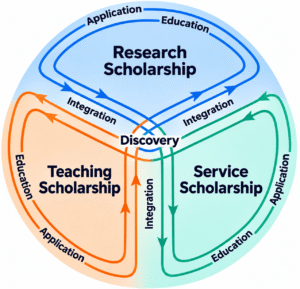
UniSCOPE recognizes scholarship as a continuum across teaching, research, and service. It helps faculty reflect on their contributions, describe their work, and plan for continued growth.
Why Broadening Scholarship Matters
Recognize More Forms of Scholarship
Traditional academic rewards emphasize basic research and conventional teaching, often undervaluing applied and interdisciplinary work. UniSCOPE offers a more inclusive framework for recognizing faculty efforts and impact.
Make Faculty Contributions Visible
Faculty can articulate the value of their teaching, service, and applied research. This approach aligns with Excelsior’s emphasis on access, innovation, and adult-focused education, supporting equity and clarity.
Understanding the UniSCOPE Model
Forms
The broad responsibilities of faculty work: teaching, research, and service. These often overlap in practice.
Functions
The intellectual purposes of scholarship: discovery, integration, application, and education.
Types
Basic, applied, pedagogical, or integrative scholarship, clarifying the work’s intent and scope.
Media
The varied outputs of scholarly work, including digital learning objects, community reports, and evaluations.
Audiences
The people who engage with and value the work, from academic peers to community partners.
Inclusive Recognition, Consistent Rigor
UniSCOPE makes scholarship standards clearer and evaluation more inclusive while maintaining rigor and expectations. Faculty can use it as a reflective and communicative tool to describe complex scholarly work.
Scholarship Across Teaching, Research, and Service
These examples show how the four scholarly functions can appear across different forms of faculty work.
Discovery
Teaching
Course innovation
Research
Original studies
Service
Problem-solving in committees
Integration
Teaching
Interdisciplinary course design
Research
Multidisciplinary research
Service
Governance and accreditation
Application
Teaching
Technical or professional training
Research
Policy research
Service
Community consulting and mentoring
Education
Teaching
Critical thinking and student growth
Research
Thesis supervision
Service
Career advising and service learning
From Practice to Scholarly Narrative
Clear documentation helps others understand and value scholarship across different evaluation processes. Describe your work through its purpose, process, rigor, and impact, aligned with UniSCOPE principles.
Recognize the value of diverse outputs, including digital learning objects, community reports, and evaluations. Rewriting a project description as a scholarly narrative can build confidence and strengthen how you frame your contributions.
Planning, Growth, and Next Steps
Use UniSCOPE to guide ongoing scholarly development as well as reflect on completed work.
- Expand a project. Engage a new audience, introduce an integrative perspective, or develop a lasting artifact.
- Identify a concrete next step. Small, intentional actions can strengthen your scholarly impact.
- Continue refining your work. Revisit your scholarly activities as projects evolve and new opportunities emerge.
Support for Your Scholarly Growth
Faculty learning communities and workshops offer ongoing support for scholarly development and planning.